
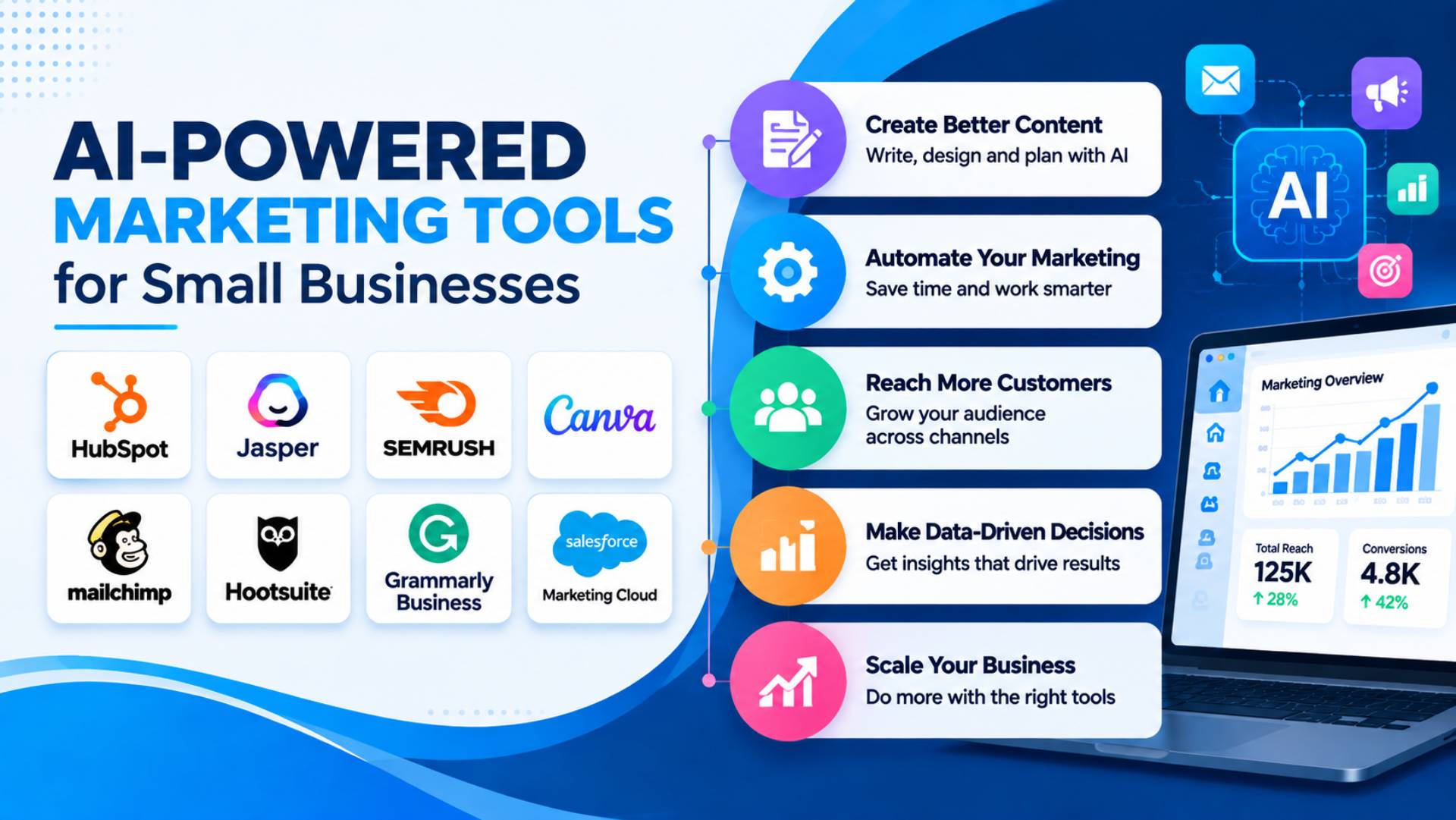
Small businesses are increasingly using artificial intelligence to improve marketing efficiency, create better customer experiences, and manage campaigns more effectively. From generating content ideas and analyzing customer data to automating repetitive workflows, AI-powered marketing tools are helping smaller teams handle complex marketing tasks without requiring large teams or advanced technical knowledge.
However, choosing the right AI marketing software can be challenging. Different platforms focus on different areas. Some specialize in AI content creation, while others provide SEO support, email automation, social media management, advertising optimization, customer engagement, or advanced analytics. The right solution depends on a company’s marketing goals, team size, budget, existing technology stack, and required level of automation. This guide compares the best AI-powered marketing tools available in 2026 to help small businesses, startups, marketers, agencies, and entrepreneurs understand what each platform offers. It explains their main capabilities, ideal use cases, limitations, pricing considerations, and how to select the right tool for specific marketing needs.
Last Updated: September 2026
TL;DR
AI-powered marketing tools can help small businesses save time, reduce repetitive work, improve content creation, and manage marketing more efficiently. In 2026, these tools cover everything from SEO and email automation to social media, design, analytics, and customer engagement. Choosing the right solution comes down to your marketing priorities, budget, ease of use, and how well it fits your existing workflow.
How We Checked This List
We reviewed each tool using official product pages, documentation, pricing information, and publicly available feature details. Our comparison focuses on AI capabilities, automation, integrations, ease of use, pricing, and suitability for small businesses.
Features and pricing can change, so always confirm the latest details with the software provider before purchasing.
Why Your AI Marketing Tool Stack Matters in 2026
Marketing teams today manage multiple channels, including websites, search engines, email campaigns, social media platforms, paid advertising, and customer communication. Choosing the right Marketing Tools can help businesses manage these channels more efficiently, improve campaign performance, and create better customer experiences.
Managing all these activities manually can become difficult, especially for small businesses with limited resources.
AI marketing tools help businesses organize and improve these workflows by supporting tasks such as:
- Creating marketing content
- Analyzing customer behavior
- Automating email campaigns
- Managing social media activity
- Improving advertising decisions
- Understanding campaign performance
- Supporting customer communication
A connected AI marketing stack can be more useful than several unrelated tools because information can move more easily between platforms. For example, a CRM-connected marketing platform can help businesses understand leads, personalize communication, and track customer journeys more effectively.
However, businesses do not need every AI tool available. The best approach is choosing platforms that solve specific marketing challenges while fitting the company’s budget, workflow, and growth plans.
Quick Answer
The best AI marketing tools depend on your business goals and the areas where you need support most. Different platforms specialise in content creation, SEO, automation, analytics, social media management, and customer engagement.
HubSpot Marketing Hub for connected CRM, automation, and marketing workflows.
Jasper for AI-assisted marketing content creation.
Semrush for keyword research, content optimisation, and search visibility.
Canva for creating marketing graphics, presentations, and branded content.
Mailchimp for email campaigns, automation, and customer journeys.
Hootsuite for social publishing, scheduling, and engagement management.
Grammarly Business for improving marketing communication and writing quality.
Salesforce Marketing Cloud for customer data, personalisation, and enterprise-level automation.
What Are AI-Powered Marketing Tools?
AI-Powered Marketing Solutions are software platforms that use artificial intelligence to support tasks such as content creation, customer analysis, campaign automation, personalization, and performance tracking.
Unlike traditional marketing software, AI marketing platforms can analyze data, identify patterns, generate recommendations, and automate repetitive tasks.
Common AI marketing capabilities include:
- Content creation and copywriting
- SEO analysis and optimization
- Social media planning
- Email automation
- Customer engagement
- Advertising optimization
- Marketing analytics
For example, AI content tools can help create marketing materials, AI SEO tools can identify optimization opportunities, and AI analytics tools can provide insights from campaign data.
AI marketing software is designed to support marketers, not replace them. Human creativity, strategy, and review remain essential for successful marketing.
How AI Marketing Tools Work
AI marketing tools collect and analyze data, generate recommendations, automate repetitive tasks, and provide insights that help businesses improve marketing performance.
1. Data Collection
AI tools gather data from websites, customer interactions, emails, social media, advertising, and sales to understand customer behavior.
2. AI Analysis
The software analyzes this data to identify trends, successful campaigns, audience interests, and potential marketing opportunities.
3. Content and Recommendations
AI can assist with blog ideas, social posts, email subject lines, ad copy, product descriptions, and campaign recommendations. Human review is still important for accuracy and brand consistency.
4. Workflow Automation
AI can automate tasks such as email follow-ups, social scheduling, lead organization, and customer record updates, saving marketing teams valuable time.
5. Performance Optimization
AI analyzes campaign results to show what is working, which audiences are responding, and where improvements may be needed.
6. Reporting and Insights
AI-powered reports make it easier to track website performance, customer engagement, leads, email results, advertising performance, and conversion trends.
What Makes an AI Marketing Tool Worth Using?
A useful AI marketing tool should solve real problems, save time, and fit easily into existing workflows. Small businesses should focus on practical value rather than choosing software simply because it includes AI.
Easy to Use
Look for a simple interface, quick setup, clear workflows, and helpful support. Teams should be able to use the main features without extensive training.
Practical Features
The tool should support important tasks such as content creation, campaign management, customer communication, analytics, or lead management.
Useful Integrations
Good AI marketing software should connect with existing CRM, email, ecommerce, analytics, advertising, and social media platforms.
Clear Pricing
Check subscription costs, user and contact limits, AI usage allowances, and premium features before choosing a plan.
Effective Automation
Useful automation can handle repetitive tasks such as email follow-ups, social scheduling, customer segmentation, and reporting.
Human Control
Marketers should be able to review and edit AI-generated content and recommendations to maintain accuracy, quality, and brand voice.
Small Business Fit
Choose software that matches your goals, team size, budget, and future growth without paying for unnecessary enterprise features.
AI-Powered Marketing Tools at a Glance
| Software | Best For | Main AI Capability | Starting Price | Main Limitation |
|---|---|---|---|---|
| HubSpot Marketing Hub | Businesses wanting connected marketing and CRM workflows | AI assistants, automation, content support, customer insights | Free tools available; paid plans vary | Advanced features require higher-tier plans |
| Jasper | Marketing teams focused on AI content creation | AI writing assistance and brand-focused content generation | Pricing varies by plan | Mainly focused on content workflows |
| Semrush | SEO and digital marketing teams | AI SEO recommendations, content optimization, and competitive research | Paid plans available | Advanced features may be costly for small teams |
| Canva | Businesses creating visual marketing materials | AI design tools and content creation support | Free plan available; paid plans vary | Not a complete marketing automation platform |
| Mailchimp | Email marketing and customer communication | AI recommendations, automation, and campaign assistance | Free plan available; paid plans vary | Advanced features require higher plans |
| Hootsuite | Social media teams | AI content suggestions and social analytics | Paid plans available | Focused mainly on social media |
| Grammarly Business | Teams improving marketing communication | AI writing assistance and editing | Paid plans available | Not designed for full marketing management |
| Salesforce Marketing Cloud | Organizations requiring advanced automation | AI-powered personalization and customer insights | Pricing available on request | More complex for small businesses |
How We Selected the Best AI Marketing Tools
The platforms included in this comparison were evaluated based on their ability to support practical marketing activities rather than simply offering AI-related features.
The evaluation criteria included:
AI Capabilities
We reviewed whether each platform provides useful AI functionality for:
- Content creation
- Recommendations
- Automation
- Customer insights
- Personalization
- Data analysis
Automation Features
AI marketing automation software should help businesses create efficient workflows by reducing repetitive tasks.
Important automation features include:
- Automated campaigns
- Customer journeys
- Lead management
- Scheduling
- Reporting
Ease of Use
Small businesses often need tools that can be adopted quickly.
Platforms with simple interfaces and accessible features are easier for teams to implement and manage.
Integrations
Integration capabilities were considered because businesses often rely on multiple marketing systems.
Useful connections include:
- CRM software
- Ecommerce platforms
- Analytics tools
- Advertising systems
- Email platforms
Content Quality
For AI content marketing tools, we considered whether platforms help businesses create useful, relevant, and editable marketing content.
Analytics and Reporting
Marketing decisions depend on accurate information.
AI analytics tools should help businesses understand:
- Campaign performance
- Customer behavior
- Engagement levels
- Marketing trends
Scalability
The best AI marketing software should support businesses as their needs grow.
A platform should ideally continue working as companies add:
- More users
- More campaigns
- More customers
- More marketing channels
Pricing and Value
Pricing information, available plans, usage limits, and included features were considered when comparing platforms.
Pricing, features, and availability should always be confirmed directly with vendors because software plans and AI capabilities change frequently.
AI Marketing Tool Reviews
1. HubSpot Marketing Hub
HubSpot also connects marketing activities with CRM Software for Small Businesses, helping companies manage leads, customer information, and communication workflows.
The platform combines marketing tools with CRM capabilities, making it useful for businesses that want customer information and marketing activities connected in one place.
HubSpot includes AI-powered features that support content creation, marketing productivity, automation workflows, and customer insights. Businesses can use these features to improve messaging, organize campaigns, and manage customer communication.
The platform supports several marketing activities, including:
- Email marketing
- Landing pages
- Lead management
- Marketing automation
- Customer analytics
- CRM-connected campaigns
Key Features
- AI writing assistance
- Marketing automation workflows
- CRM integration
- Email campaign management
- Lead tracking
- Customer insights
Strengths
- Strong all-in-one marketing ecosystem
- Useful CRM connection
- Suitable for growing businesses
- Supports multiple marketing channels
Limitations
- Advanced automation and reporting require higher-tier plans
- Costs may increase as businesses add more features
HubSpot Marketing Hub is perfect for:
- Small businesses building structured marketing workflows
- Startups needing CRM-connected marketing
- Teams managing leads and customer communication
HubSpot Marketing Hub is not suited for:
- Businesses looking only for a simple AI writing tool
- Users wanting a standalone low-cost AI solution
2. Jasper
Jasper is an AI content marketing platform designed to help businesses create marketing content more efficiently. Among the growing range of AI Content Creation Tools, Jasper focuses on AI-assisted writing, brand consistency, and content workflows.
The platform focuses on AI-assisted writing, brand consistency, and content workflows. Marketing teams can use Jasper to create campaign copy, blog drafts, product messaging, social media content, and other written materials.
Jasper is particularly useful for companies that produce frequent marketing content and want assistance maintaining a consistent brand style.
Key Features
- AI content generation
- Brand voice customization
- Marketing templates
- Content collaboration
- Campaign content support
Strengths
- Strong focus on marketing content
- Useful for content teams
- Supports brand-focused writing
Limitations
- Primarily focused on content creation
- Businesses may need additional tools for SEO, analytics, and automation
Jasper is perfect for:
- Content marketers
- Marketing agencies
- Businesses producing regular campaigns
Jasper is not suited for:
- Companies needing complete marketing automation
- Businesses mainly looking for analytics solutions
3. Semrush
Semrush is a digital marketing platform focused on SEO, content marketing, competitor research, and online visibility analysis. It is widely used by businesses that want to improve search performance and understand how their website compares with competitors.
The platform provides AI-supported features that assist marketers with content optimization, keyword research, search analysis, and marketing insights. These capabilities help businesses identify opportunities to improve their online presence and create more targeted content.
Semrush is particularly valuable for companies where organic search traffic is an important part of their marketing strategy.
Key Features
- AI SEO recommendations
- Keyword research
- Content optimization
- Competitor analysis
- Website audits
- Marketing reports
- Search performance tracking
Strengths
- Strong SEO capabilities
- Large amount of marketing data
- Useful competitor research features
- Supports content and search marketing workflows
Limitations
- Advanced features may be expensive for very small businesses
- Some features require time to learn and understand
Semrush is perfect for:
- SEO teams
- Content marketers
- Businesses focused on search visibility
- Agencies managing multiple websites
Semrush is not suited for:
- Businesses looking only for AI content creation
- Companies needing a simple design or email marketing solution
4. Canva
Canva is a visual communication and design platform that helps businesses create marketing materials, presentations, social media graphics, advertisements, and branded content.
Through its AI-powered design features, Canva helps users create and edit visual content more efficiently. This makes it useful for small businesses that need professional-looking marketing assets without hiring dedicated designers.
The platform combines templates, design tools, collaboration features, and AI assistance in one workspace.
Businesses can use Canva for:
- Social media graphics
- Marketing banners
- Presentations
- Promotional materials
- Brand assets
- Visual campaigns
Key Features
- AI-assisted design tools
- Image generation and editing
- Marketing templates
- Brand management
- Social media content creation
- Team collaboration
- Presentation creation
Strengths
- Easy to learn
- Large template library
- Useful for businesses without design teams
- Supports many marketing content formats
Limitations
- Not a complete marketing automation platform
- Does not replace advanced SEO, CRM, or analytics software
Canva is perfect for:
- Small businesses without designers
- Social media teams
- Content marketers
- Entrepreneurs creating their own marketing materials
Canva is not suited for:
- Advanced CRM automation
- Detailed marketing analytics
- Specialized SEO research
5. Mailchimp
Mailchimp is one of the useful AI Customer Engagement Tools designed to help businesses communicate with customers, manage audiences, and create automated campaigns.
The platform provides AI-assisted features that support email creation, campaign improvements, audience management, and customer communication.
Mailchimp is especially useful for small businesses that want to build stronger relationships with customers through email marketing without managing complicated systems.
Businesses can use Mailchimp to create:
- Email newsletters
- Automated campaigns
- Customer journeys
- Promotional emails
- Ecommerce communications
Key Features
- Email marketing
- Marketing automation
- Customer journeys
- AI-assisted content features
- Audience segmentation
- Campaign reporting
- Ecommerce integrations
Strengths
- Strong email marketing capabilities
- Easy campaign creation
- Useful automation features
- Suitable for small businesses
Limitations
- Advanced features require higher plans
- Businesses needing SEO, social media, or CRM functionality may require additional tools
Mailchimp is perfect for:
- Small business email marketing
- Ecommerce communication
- Customer engagement campaigns
Mailchimp is not suited for:
- Businesses needing advanced SEO tools
- Companies wanting a complete CRM system
- Teams focused mainly on social media marketing
6. Hootsuite
Businesses looking for Social Media Management Tools can use platforms like Hootsuite to organize publishing schedules, track engagement, and manage multiple channels.
The platform supports AI-assisted content creation, scheduling, and social media insights. It is useful for businesses managing multiple social channels and looking to organize their publishing workflow.
Instead of switching between different social networks, teams can manage several accounts from one platform.
Key Features
- Social media scheduling
- AI-assisted content suggestions
- Social monitoring
- Content planning
- Analytics and reporting
- Team collaboration
Strengths
- Strong social media management capabilities
- Helps organize multiple accounts
- Useful reporting features
- Supports team workflows
Limitations
- Mainly focused on social media
- Not a complete SEO, email, or CRM platform
Hootsuite is perfect for:
- Social media managers
- Marketing agencies
- Businesses publishing frequently on social platforms
Hootsuite is not suited for:
- SEO-focused teams
- Businesses mainly needing email automation
- Companies with limited social activity
7. Grammarly Business
Grammarly Business is an AI-powered writing and communication platform that helps teams improve written content across business workflows.
For marketers, Grammarly can support content editing, rewriting, tone improvement, and communication quality. It can help improve emails, landing page copy, social media posts, sales messages, and other marketing materials.
While Grammarly provides valuable AI writing support, it should be viewed as a productivity tool rather than a complete marketing platform.
Key Features
- AI writing assistance
- Grammar and spelling improvement
- Tone suggestions
- Content rewriting
- Generative AI assistance
- Team writing support
Strengths
- Easy integration into daily writing workflows
- Helps improve content clarity
- Useful for marketing communication
Limitations
- Does not provide full marketing automation
- Not designed for SEO research or campaign analytics
Grammarly Business is perfect for:
- Marketing teams
- Content writers
- Sales teams creating written communication
Grammarly Business is not suited for:
- Marketing automation
- SEO management
- Social media scheduling
8. Salesforce Marketing Cloud
Salesforce Marketing Cloud is a marketing technology platform designed around customer data, personalization, automation, and multichannel engagement.
The platform connects marketing activities with customer information, helping organizations create personalized experiences and manage complex customer journeys.
Its AI capabilities are closely connected with the Salesforce ecosystem, making it especially useful for organizations already using Salesforce CRM.
Businesses can use Salesforce Marketing Cloud for:
- Customer segmentation
- Marketing automation
- Personalized campaigns
- Customer journeys
- Analytics
- CRM-connected marketing
Key Features
- AI-assisted marketing capabilities
- Customer data management
- Marketing automation
- Personalization
- Analytics
- Journey management
- Salesforce CRM integration
Strengths
- Powerful customer data capabilities
- Advanced personalization options
- Strong enterprise marketing automation
Limitations
- More complex than many small businesses require
- Implementation and pricing may be higher compared with simpler tools
Salesforce Marketing Cloud is perfect for:
- Organizations already using Salesforce
- Businesses requiring advanced personalization
- Larger marketing teams
Salesforce Marketing Cloud is not suited for:
- Very small businesses needing simple tools
- Companies looking only for AI content creation
- Teams wanting a lightweight marketing solution
AI Marketing Tools Comparison
The following comparison highlights the main strengths of each platform. These categories describe functionality rather than numerical rankings.
| Software | AI Features | Automation | Marketing Use Cases | Integrations | Best For | Pricing |
|---|---|---|---|---|---|---|
| HubSpot Marketing Hub | Excellent | Excellent | CRM, email, content, leads, campaigns | Excellent | All-in-one marketing | Free tools and paid plans |
| Jasper | Excellent | Good | Content and campaign creation | Good | AI content teams | Paid plans |
| Semrush | Strong | Good | SEO, content, competitor research | Strong | SEO teams | Paid plans |
| Canva | Strong | Good | Design, visual content, social assets | Strong | Visual marketing | Free and paid plans |
| Mailchimp | Strong | Strong | Email, customer journeys, ecommerce | Strong | Email marketing | Plan-dependent |
| Hootsuite | Strong | Strong | Social publishing and management | Strong | Social media teams | Paid plans |
| Grammarly Business | Strong | Limited | Writing and communication | Good | Marketing writing | Free and paid options |
| Salesforce Marketing Cloud | Excellent | Excellent | Personalization, journeys, CRM marketing | Excellent | Advanced marketing operations | Pricing available on request |
Which AI Marketing Tool Is Best for Your Business?
The right AI marketing platform depends on the business type, marketing goals, and existing technology setup.
Small Businesses
Small businesses should focus on usability, affordability, and practical features.
HubSpot can help businesses connect marketing with CRM and customer management, while Canva can support everyday marketing design needs.
Startups
Startups usually need flexible tools that provide multiple capabilities without unnecessary complexity.
Platforms such as HubSpot, Canva, and Grammarly can support early marketing activities while keeping workflows manageable.
Ecommerce Businesses
Ecommerce companies often need strong customer communication and creative marketing support.
Mailchimp can support email campaigns and customer journeys, while Canva can help create promotional visuals.
Marketing Agencies
Agencies often require specialized tools for different client needs.
A combination of platforms may work better:
- Semrush for SEO research
- Hootsuite for social media management
- Jasper for content assistance
- Canva for visual assets
Content Marketers
Content-focused teams may benefit from:
- Jasper for content creation
- Grammarly for editing and communication improvement
- Semrush for SEO optimization
Together, these tools can support the content production process from planning to improvement.
SEO Teams
Semrush is the strongest fit for teams focused primarily on search visibility, keyword research, competitor analysis, and content optimization.
Social Media Teams
Hootsuite is designed specifically for managing social media activity, while Canva can support the creation of visual content.
Email Marketers
Mailchimp provides email campaigns, automation, audience management, and customer communication features.
Businesses requiring deeper CRM connections may also consider HubSpot.
Sales Teams
HubSpot can connect marketing activities with leads and customer information.
Organizations already using Salesforce may find Salesforce Marketing Cloud more suitable for advanced customer management.
Budget-Conscious Businesses
Businesses searching for Affordable AI Marketing Software should avoid purchasing multiple overlapping tools immediately.
Start by identifying the biggest marketing challenge and choose a platform that solves that problem effectively. Free plans and trials can help businesses test whether a tool fits before making a larger investment.
How to Choose the Right AI Marketing Tool
Selecting the right AI marketing software requires more than comparing feature lists. Businesses should focus on their actual marketing goals, existing systems, budget, and future requirements.
The best tool is one that fits naturally into daily workflows and provides practical value.
Define Your Marketing Goals
Before choosing an AI marketing platform, identify the specific marketing challenges you want to solve.
Different businesses may need AI support for different activities, such as:
- Content creation
- Search engine optimization
- Social media management
- Email automation
- Advertising campaigns
- Customer support
- Analytics and reporting
- Lead generation
For example, a company struggling to create regular social media content may benefit from a design or content-focused AI tool. A business trying to improve search visibility may need an AI SEO platform instead.
Understanding your priorities prevents investing in features that your team may never use.
Check AI Capabilities
The term “AI-powered” can mean different things depending on the platform.
Some tools focus on content generation, while others analyze customer data, automate workflows, or provide recommendations.
Before choosing software, review whether the AI features match your requirements.
Consider:
- AI content generation
- AI assistants
- Automated recommendations
- Customer personalization
- Predictive insights
- Workflow automation
- Data analysis
Businesses should also consider how much control users have over AI outputs. The ability to review, edit, and approve AI-generated content is important for maintaining quality and accuracy.
Evaluate Integrations
A marketing tool becomes more valuable when it works well with the systems your business already uses.
Before purchasing, check whether the platform integrates with:
- CRM software
- Ecommerce platforms
- Analytics systems
- Advertising platforms
- Email marketing tools
- Social media networks
- Productivity applications
Strong integrations reduce manual work and help businesses create more connected marketing workflows.
Review the Full Pricing Structure
Businesses should look beyond the starting price when comparing AI marketing software.
Important pricing factors include:
- Number of users
- Contact limits
- AI usage limits
- Content credits
- Automation features
- Premium integrations
- Reporting features
- Additional workspaces or brands
A platform that appears affordable at first may become more expensive as your marketing operations expand.
Consider Scalability
A marketing tool should support your business as it grows.
Consider whether the platform can handle:
- More employees
- Additional campaigns
- Larger customer databases
- New marketing channels
- Increased automation requirements
At the same time, avoid paying for advanced enterprise features that your business does not currently need.
Test Before Buying
Whenever possible, test an AI marketing platform before making a long-term commitment.
Use available:
- Free plans
- Free trials
- Product demonstrations
Test real marketing activities instead of only exploring features.
For example:
- Create an actual email campaign
- Generate sample content
- Schedule social posts
- Review analytics reports
- Connect existing systems
This helps determine whether the tool improves your workflow in practice.
Common Mistakes When Choosing AI Marketing Software
Choosing AI marketing software without proper evaluation can lead to wasted time and unnecessary costs.
Avoid these common mistakes.
Choosing a Tool Because It Has AI Features
AI alone does not create business value.
A platform should be selected because its features solve a real marketing problem, not simply because it advertises artificial intelligence.
Focus on what the AI actually helps you accomplish.
Ignoring Existing Workflows
Adding new software without considering existing processes can create more complexity.
Before investing in another platform, review:
- Current marketing tools
- Team responsibilities
- Existing processes
- Data management requirements
A new tool should simplify work, not make it harder.
Failing to Check Integrations
A powerful AI platform may become frustrating if it cannot connect with your existing systems.
Businesses should confirm integration options before subscribing, especially when marketing depends on:
- CRM data
- Customer records
- Ecommerce information
- Analytics platforms
- Advertising accounts
Overlooking AI Usage Limits
Many AI platforms include limits based on pricing plans.
These may include restrictions on:
- AI generations
- Content credits
- Users
- Contacts
- Automation actions
- Advanced features
Understanding these limits helps businesses choose realistic plans.
Expecting AI to Replace Marketing Strategy
AI can support marketing teams, but it does not replace strategic thinking.
Successful marketing still requires:
- Understanding customers
- Creating strong messaging
- Building trust
- Making business decisions
- Reviewing campaign performance
AI works best as a productivity tool that supports human expertise.
Ignoring Privacy and Data Handling
Businesses should understand how AI platforms manage information before uploading customer or company data.
Important considerations include:
- Data security
- Privacy policies
- Information storage
- User permissions
- Data usage practices
This is especially important for companies handling customer information.
Buying Too Many Similar Tools
Small businesses can easily spend money on multiple platforms that perform similar tasks.
Before adding another AI tool, ask:
- Does an existing platform already provide this feature?
- Will this tool save meaningful time?
- Does it improve an important workflow?
A smaller, connected technology stack is often easier to manage.
Choosing Software That Cannot Grow
A basic tool may work initially but become limiting as marketing needs increase.
Consider future requirements involving:
- Team expansion
- More campaigns
- Additional channels
- Larger customer databases
- Advanced automation
Choosing software with reasonable scalability can prevent future migration problems.
Building a Practical AI Marketing Stack for a Small Business
A more practical approach to Digital Marketing Automation with AI is to build a stack around a few core requirements. For example, a company might use an all-in-one platform for CRM and email, a specialized SEO tool for organic search, and a design platform for creative production.
A balanced AI marketing stack may include:
- An all-in-one marketing platform for customer management and automation
- An SEO tool for search visibility
- A content tool for writing assistance
- A design platform for visual marketing
- An email platform for customer communication
- A social media management tool for publishing and engagement
The exact combination depends on business needs.
For example:
A content-focused business may prioritize:
- Jasper for content assistance
- Semrush for SEO research
- Canva for visual assets
An ecommerce business may focus more on:
- Mailchimp for customer communication
- Canva for promotional materials
- HubSpot for customer relationship management
The most important factor is how well the tools work together.
Before adding another subscription, ask:
- What specific marketing problem will this tool solve?
- Does an existing platform already provide this capability?
- Can this tool connect with our current systems?
A carefully selected AI marketing stack helps businesses improve efficiency while keeping technology manageable.
Final Thoughts
The best 2026 AI Marketing Trends are not only about adding more artificial intelligence features. The most useful AI-powered marketing tools are those that solve genuine marketing problems, fit existing workflows, connect with important business systems, and remain affordable as usage grows.
Different platforms serve different purposes.
HubSpot Marketing Hub is designed for businesses wanting connected CRM and marketing automation. Jasper supports AI-assisted content creation. Semrush helps with SEO and competitive research. Canva supports visual marketing. Mailchimp focuses on email campaigns and customer communication. Hootsuite helps manage social media activity. Grammarly improves marketing communication, while Salesforce Marketing Cloud supports advanced customer data and personalization workflows.
Before investing in AI marketing software, businesses should identify their most important marketing needs, compare shortlisted platforms, review pricing and limitations, and test tools with real workflows whenever possible.
The right AI marketing stack is not about using the most tools. It is about selecting the tools that help your business work smarter, improve customer experiences, and support sustainable marketing growth.