
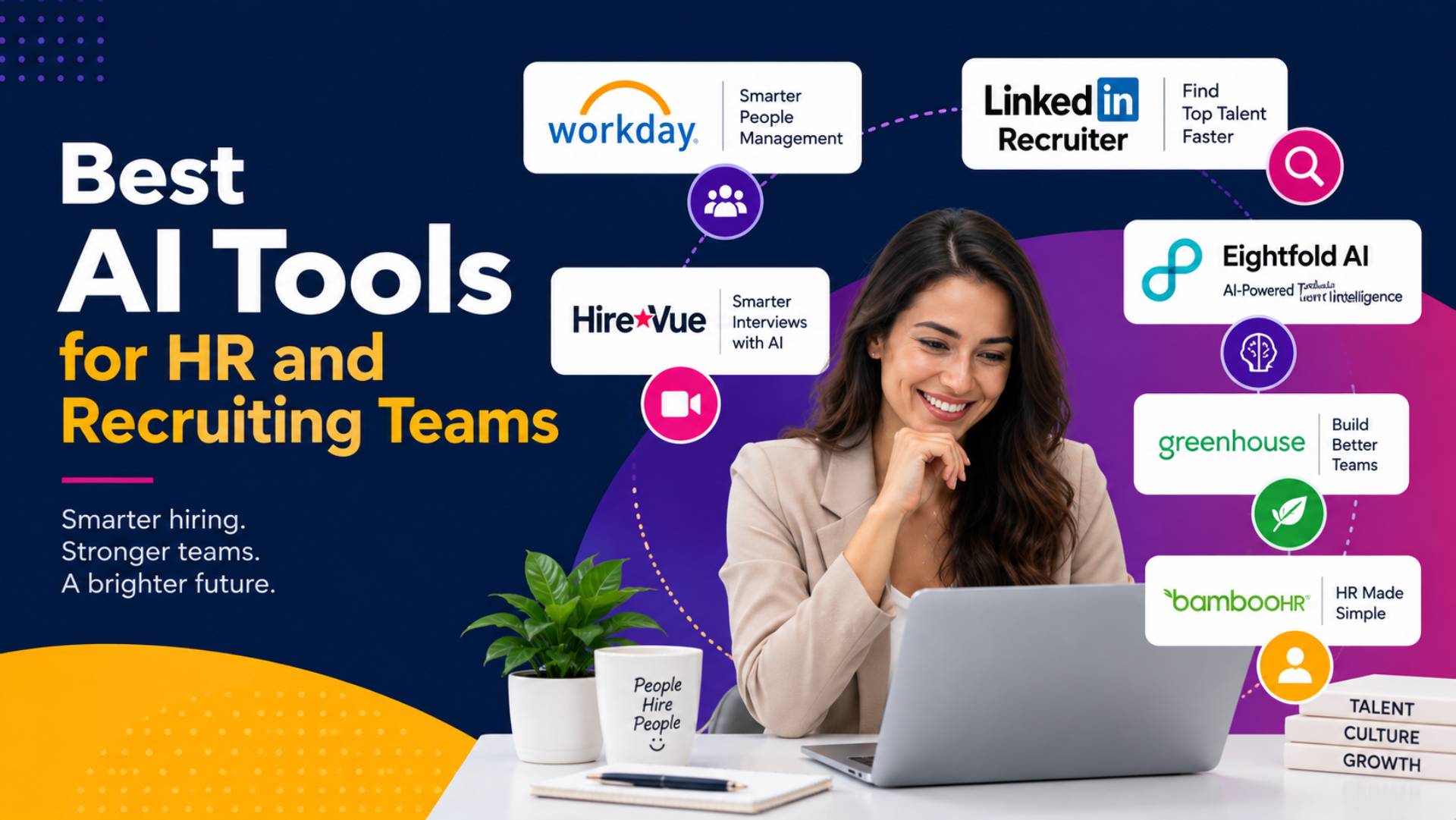
Add after the second sentence: Modern AI Tools for HR Teams help organisations automate repetitive tasks, improve decision-making, and create more efficient hiring processes. HR teams that once spent hours reviewing applications, scheduling interviews, and handling repetitive administrative tasks can now use AI-powered software to improve speed, accuracy, and productivity.
Recruitment has become more challenging in recent years. Companies need to attract skilled candidates, reduce hiring delays, improve candidate experiences, and make better workforce decisions. AI tools for HR help organisations automate routine processes while allowing recruiters to focus more on human interaction, strategy, and relationship building.
The best AI tools for HR and recruiting teams in 2026 combine automation, analytics, candidate matching, workflow management, and intelligent recommendations. Choosing the right AI Recruiting Software allows businesses to improve candidate sourcing, screening, and recruitment workflows while maintaining human oversight However, every organisation has different needs. A startup looking for affordable recruitment support may need a different solution compared with a global enterprise managing thousands of employees.
This guide compares the best AI tools for HR and recruiting teams in 2026 based on AI capabilities, ease of use, integrations, pricing value, security features, and practical business applications. It explains what each platform does, who it suits best, its strengths and limitations, and how HR professionals can choose the right technology for their hiring goals.
Key Takeaways
Modern tools help teams automate repetitive work, improve candidate sourcing, streamline interviews, and support workforce planning.
Workday focuses on enterprise HR management, LinkedIn Recruiter on sourcing, HireVue on interviews, Eightfold AI on talent intelligence, Greenhouse on hiring workflows, and BambooHR on SMB HR management.
AI can support screening, matching, scheduling, and analysis, but important hiring decisions should still involve qualified people and clear accountability.
Businesses should check how well a platform connects with existing HR systems and how it handles sensitive candidate and employee data.
Companies should compare pricing, usability, scalability, AI capabilities, security, and recruitment goals before choosing an HR platform.
Quick Comparison Table
| Tool | Best For | Key Features | Pricing | AI Capabilities |
|---|---|---|---|---|
| Workday | Enterprise HR teams | Workforce management, recruiting, analytics | Custom pricing | AI workforce insights, automation |
| LinkedIn Recruiter | Talent sourcing | Candidate search, recruitment tools | Custom pricing | AI recommendations and matching |
| HireVue | AI interviews | Video interviews, assessments | Custom pricing | Interview analysis and automation |
| Eightfold AI | Enterprise recruiting | Talent intelligence, candidate matching | Custom pricing | AI talent matching |
| Greenhouse | Growing companies | Applicant tracking, hiring workflows | Custom pricing | Automation and hiring insights |
| BambooHR | Small and medium businesses | HR management, employee tools | Subscription plans | AI-assisted HR workflows |
What Are AI Tools for HR and Recruiting?
AI tools for HR are software platforms that use artificial intelligence to support human resource activities such as recruitment, employee management, workforce planning, and administrative processes.
These tools analyse large amounts of information, identify patterns, automate repetitive work, and provide recommendations that help HR professionals make informed decisions.
Many organisations now use the best HR Automation Tools to reduce manual administration and improve everyday HR operations.
Common uses of AI in HR include:
- Screening resumes and identifying suitable candidates
- Automating interview scheduling
- Matching candidates with job requirements
- Creating job descriptions
- Supporting employee onboarding
- Analysing workforce data
- Answering employee questions through AI assistants
AI does not replace the human role in HR. Instead, it helps teams reduce manual workloads and spend more time on activities that require communication, judgement, and relationship building.
AI HR Market Overview 2026
The HR technology market continues to move towards automation, personalisation, and data-driven decision-making. Businesses are increasingly adopting AI solutions to improve recruitment efficiency, manage workforce challenges, and create better employee experiences. Like other business Software Tools, HR platforms should be evaluated based on usability, integrations, and practical value
Understanding HR Technology Trends 2026 helps organisations identify where artificial intelligence is creating new opportunities in recruitment, workforce management, and employee experience.
Several major trends are shaping AI adoption in HR:
Increased Recruitment Automation
Recruiters are using AI-powered systems to manage high-volume hiring activities. These AI-Powered Hiring Solutions help companies manage candidate pipelines, automate repetitive activities, and improve recruitment efficiency. Automated screening, candidate ranking, and interview scheduling allow teams to handle recruitment processes more efficiently.
Greater Focus on Talent Intelligence
Modern HR platforms are moving beyond basic applicant tracking. AI tools now analyse skills, experience, and workforce data to help companies identify suitable candidates and plan future hiring needs.
Human-Centred AI Adoption
Companies are focusing on responsible AI implementation. Human oversight, transparency, privacy protection, and fair hiring practices remain important when using AI recruitment technology.
AI-Powered Employee Support
Businesses are also using AI assistants to answer employee questions, support onboarding, and improve access to HR information.
How We Selected These AI Tools
To create this comparison, each AI HR platform should be evaluated using clear criteria focused on real buyer needs. When comparing Recruiting AI Platforms, organisations should consider factors such as accuracy, integrations, security, usability, and overall business value.
AI Features
The evaluation considers:
- Candidate sourcing capabilities
- Resume screening functionality
- Interview automation
- Candidate matching accuracy
- Employee assistance features
- Workflow automation
- Reporting and analytics
Ease of Use
A useful HR platform should be simple for teams to adopt. Factors considered include:
- User interface quality
- Setup process
- Learning requirements
- Daily usability
Integrations
Modern HR teams depend on connected systems. Important integration areas include:
- Applicant tracking systems
- HR management platforms
- Payroll software
- Communication tools
- Business applications
Pricing Value
Pricing evaluation considers:
- Available plans
- Free options where available
- Paid features
- Enterprise pricing models
- Overall value for different company sizes
Security and Compliance
AI HR tools handle sensitive employee and candidate information. Important considerations include:
- Data security
- Privacy controls
- Responsible AI practices
- Hiring fairness measures
Ranking Methodology
The comparison framework evaluates tools across multiple categories:
| Category | Weight |
|---|---|
| AI Features | 25% |
| Ease of Use | 20% |
| Pricing Value | 20% |
| Integrations | 15% |
| Security | 10% |
| Customer Feedback | 10% |
The ranking approach focuses on overall usefulness rather than a single feature. Different companies may prioritise different factors depending on their hiring volume, budget, industry, and workforce requirements.
1. Workday: Enterprise HR Platform With AI Workforce Intelligence
Workday is an enterprise human capital management platform designed to help large organisations manage employees, recruitment, payroll, finance, and workforce planning from one system.
Its AI capabilities support HR teams by analysing workforce information, improving decision-making, and helping organisations understand talent trends. The platform is mainly designed for medium-sized and large companies that require advanced HR management capabilities.
Workday is included in this comparison because it represents the enterprise category of AI-powered HR software. Companies managing complex workforce operations often look for platforms that combine recruitment, employee management, analytics, and automation.
What You Get vs What You Don’t Get
| What You Get | What You Don’t Get |
|---|---|
| Enterprise HR management features | May require implementation support |
| Workforce analytics capabilities | Can be complex for small teams |
| Recruitment workflow support | Pricing is not designed for limited budgets |
| Scalable HR infrastructure | Custom setup may take time |
Key Features
- AI-powered workforce insights
- Recruitment management
- Employee data management
- HR analytics
- Talent planning tools
- Enterprise integrations
- Reporting capabilities
- Security controls
Workday Pricing
Workday generally follows a custom pricing model based on business size, selected modules, workforce requirements, and implementation needs.
Companies usually receive pricing through a personalised quote rather than a fixed public subscription plan.
Pricing suitability:
- Small businesses: May find Workday more advanced and expensive than required.
- Mid-size companies: Suitable for organisations growing their HR operations.
- Enterprise companies: Designed for large organisations requiring a complete HR technology system.
Best For
Workday is best suited for:
✓ Large organisations with complex HR requirements
✓ Global companies managing large workforces
✓ Businesses needing workforce analytics and planning
✓ Enterprise HR departments requiring connected systems
Not Ideal For
Workday may not be the right choice for:
- Small companies needing simple HR software
- Teams with limited implementation resources
- Businesses looking only for basic recruitment features
2. LinkedIn Recruiter: AI-Powered Talent Sourcing Platform
LinkedIn Recruiter is a recruitment platform built around the world’s largest professional network. It helps hiring teams discover candidates, search for specific skills, communicate with potential applicants, and manage recruitment outreach.
The platform uses AI-powered recommendations to help recruiters identify suitable candidates based on job requirements, skills, experience, and professional information.
LinkedIn Recruiter is included in this comparison because sourcing qualified candidates remains one of the biggest challenges for HR teams. The platform focuses strongly on talent discovery and recruiter productivity.
What You Get vs What You Don’t Get
| What You Get | What You Don’t Get |
|---|---|
| Large professional candidate database | Full HR management system |
| Candidate search and recommendations | Complete payroll features |
| Recruitment communication tools | Replacement for all HR software |
| Talent discovery features | May require additional recruitment tools |
Key Features
- AI candidate recommendations
- Advanced candidate search filters
- Recruiter messaging tools
- Talent insights
- Candidate organisation features
- Recruitment collaboration tools
- Professional network access
- Hiring workflow support
LinkedIn Recruiter Pricing
LinkedIn Recruiter typically uses custom pricing based on recruitment requirements, company size, and selected features.
Pricing depends on factors such as:
- Number of recruiters using the platform
- Hiring volume
- Required features
- Enterprise requirements
Pricing suitability:
- Small businesses: Suitable when actively hiring specialised roles.
- Mid-size companies: Useful for growing recruitment teams.
- Large companies: Valuable for high-volume talent sourcing.
Best For
LinkedIn Recruiter is best suited for:
✓ Recruitment teams sourcing professional talent
✓ Companies hiring specialised roles
✓ Businesses needing candidate discovery tools
✓ Talent acquisition professionals
Not Ideal For
It may not be the best option for:
- Businesses needing complete HR management software
- Companies with very limited recruitment activity
- Organisations looking only for employee management tools
3. HireVue: AI Interview Platform for Modern Recruitment
HireVue is an AI-powered recruitment platform focused on video interviews, candidate assessments, and hiring automation. For companies managing large hiring campaigns, AI Interview Tools for Recruiters can help organise assessments, improve interview consistency, and reduce scheduling challenges. It helps organisations manage early-stage recruitment processes and evaluate candidates more efficiently.
The platform is designed for companies that conduct large numbers of interviews and want to improve consistency during candidate evaluation.
HireVue is included because interview management is a major area where AI can help HR teams save time while creating more organised hiring workflows.
HireVue Pricing
HireVue follows a custom pricing model based on company requirements, hiring volume, selected features, and recruitment needs.
The platform does not typically display fixed public pricing because costs can vary depending on implementation size and business requirements.
Pricing suitability:
- Small businesses: May be suitable for companies with regular hiring needs but may be more advanced than required for occasional recruitment.
- Mid-size companies: Useful for businesses managing multiple interviews and hiring campaigns.
- Enterprise companies: Designed for organisations handling large-scale recruitment.
Best For
HireVue is best suited for:
✓ Companies conducting frequent interviews
✓ Large recruitment teams
✓ Businesses needing structured candidate assessments
✓ Organisations hiring at scale
Not Ideal For
HireVue may not be the right choice for:
- Small businesses with very limited hiring activity
- Companies wanting only basic applicant tracking
- Teams that prefer fully manual interview processes
4. Eightfold AI: AI Talent Intelligence Platform for Enterprise Hiring
Eightfold AI is an AI-powered talent intelligence platform designed to help organisations improve recruitment, workforce planning, and employee development. As one of the advanced Talent Acquisition AI Tools available today, it focuses on helping organisations identify skills, match candidates, and improve workforce decisions.The platform uses artificial intelligence to analyse skills, experience, and career information to support talent decisions.
Unlike traditional recruitment software that mainly tracks applicants, Eightfold AI focuses on understanding talent capabilities and matching people with suitable opportunities.
The platform is included in this comparison because many organisations are moving towards skills-based hiring and using AI to improve how they identify, attract, and retain talent.
What You Get vs What You Don’t Get
| What You Get | What You Don’t Get |
|---|---|
| AI-powered talent matching | May be complex for small teams |
| Skills-based recruitment support | Not designed for basic hiring needs |
| Workforce intelligence features | Requires proper implementation |
| Enterprise talent insights | Pricing may not suit smaller budgets |
Key Features
- AI candidate matching
- Talent intelligence
- Skills-based hiring
- Recruitment automation
- Internal mobility support
- Workforce planning
- Candidate discovery
- Talent analytics
Eightfold AI Pricing
Eightfold AI generally uses custom pricing based on organisation size, required solutions, and implementation needs.
Pricing factors may include:
- Number of employees
- Recruitment requirements
- Selected modules
- Enterprise support needs
Pricing suitability:
- Small businesses: May be more advanced than required.
- Mid-size companies: Suitable for companies expanding recruitment operations.
- Enterprise companies: Strong fit for large-scale talent management.
Best For
Eightfold AI is best suited for:
✓ Large organisations with complex hiring needs
✓ Companies using skills-based recruitment
✓ Businesses focused on workforce planning
✓ Enterprise talent acquisition teams
Not Ideal For
It may not be suitable for:
- Small companies needing simple recruitment software
- Businesses hiring only occasionally
- Teams looking for a low-cost ATS solution
5. Greenhouse: Applicant Tracking and Hiring Workflow Platform
Greenhouse is a recruitment platform focused on applicant tracking, hiring workflows, candidate management, and structured recruitment processes. It helps companies organise hiring activities from job creation through candidate onboarding.
The platform is popular among growing businesses that need a reliable recruitment system without adopting a complete enterprise HR suite.
Greenhouse is included because many organisations need better recruitment organisation, collaboration, and hiring consistency rather than only AI automation.
Greenhouse Pricing
Greenhouse generally follows a custom pricing structure based on company size, recruitment requirements, number of users, and selected features.
The platform does not typically provide a fixed public pricing list because recruitment needs vary between organisations.
Pricing suitability:
- Small businesses: Suitable for growing companies that need organised hiring workflows.
- Mid-size companies: A strong option for teams managing regular recruitment.
- Enterprise companies: Useful when structured hiring processes are required across departments.
Best For
Greenhouse is best suited for:
✓ Growing companies building structured hiring processes
✓ Recruitment teams managing multiple candidates
✓ Businesses wanting better hiring collaboration
✓ Organisations focused on consistent recruitment workflows
Not Ideal For
Greenhouse may not be suitable for:
- Companies needing a complete HR management platform
- Businesses looking only for advanced AI talent intelligence
- Small teams with very occasional hiring needs
6. BambooHR: AI-Assisted HR Software for Small and Medium Businesses
BambooHR is a human resources management platform designed mainly for small and medium-sized businesses. It helps organisations manage employee information, hiring processes, onboarding, performance management, and HR administration.
The platform focuses on making HR tasks simpler for businesses that may not need complex enterprise solutions.
BambooHR is included in this comparison because many smaller companies are looking for affordable and easy-to-use HR technology that can support daily employee management and recruitment activities.
What You Get vs What You Don’t Get
| What You Get | What You Don’t Get |
|---|---|
| AI-powered talent matching | May be complex for small teams |
| Skills-based recruitment support | Not designed for basic hiring needs |
| Workforce intelligence features | Requires proper implementation |
| Enterprise talent insights | Pricing may not suit smaller budgets |
Key Features
- Employee database management
- Recruitment support
- Applicant tracking
- Employee onboarding
- HR reporting
- Performance management
- Workflow automation
- Employee self-service tools
BambooHR Pricing
BambooHR uses subscription-based pricing, with costs depending on company size, selected features, and required services.
Businesses usually choose plans based on:
- Number of employees
- HR features required
- Additional tools and integrations
Pricing suitability:
- Small businesses: Strong fit due to simplicity and accessibility.
- Mid-size companies: Suitable for growing HR departments.
- Enterprise companies: May require more advanced HR platforms.
Best For
BambooHR is best suited for:
✓ Small and medium businesses
✓ Companies needing simple HR management
✓ Teams replacing manual HR processes
✓ Businesses wanting easy employee administration
Not Ideal For
BambooHR may not be the best choice for:
- Large global enterprises
- Companies requiring advanced AI recruitment intelligence
- Organisations managing very complex workforce structures
Best AI HR Tools By Use Case
Best AI Recruiting Tool: Eightfold AI
Eightfold AI is designed for organisations that want advanced AI-powered talent matching and skills-based recruitment. It is especially useful for businesses managing large candidate pools and complex hiring requirements.
Best AI Tool for Small Businesses: BambooHR
BambooHR is suitable for smaller organisations that need simple HR management, employee organisation, and recruitment support without unnecessary complexity.
Best Enterprise AI HR Platform: Workday
Workday provides a broad HR ecosystem for organisations requiring workforce management, analytics, recruitment, and employee data management in one platform.
Best Resume Screening Tool: Eightfold AI
Modern AI Resume Screening Tools help recruiters analyse candidate information, identify relevant skills, and manage large applicant volumes more efficiently. Eightfold AI is one example of a platform focused on intelligent talent matching.
Best AI Interview Tool: HireVue
HireVue focuses on interview automation and digital assessments, making it useful for companies managing high-volume recruitment.
Best Budget-Friendly Option: BambooHR
BambooHR is designed for businesses that need practical HR features without the complexity of enterprise platforms.
Feature Comparison Matrix
| Feature | Workday | LinkedIn Recruiter | HireVue | Eightfold AI | Greenhouse | BambooHR |
|---|---|---|---|---|---|---|
| Resume Screening | ✓ | ✓ | ✓ | ✓ | ✓ | ✓ |
| Candidate Matching | ✓ | ✓ | Limited | ✓ | Limited | Limited |
| AI Interview Support | Limited | Limited | ✓ | Limited | Limited | Limited |
| HR Automation | ✓ | Limited | Limited | ✓ | ✓ | ✓ |
| Analytics | ✓ | ✓ | ✓ | ✓ | ✓ | ✓ |
| Integrations | ✓ | ✓ | ✓ | ✓ | ✓ | ✓ |
| Pricing Model | Custom | Custom | Custom | Custom | Custom | Subscription |
Free vs Paid AI HR Tools
Many businesses begin with basic or lower-cost HR solutions before investing in advanced AI platforms. The right choice depends on recruitment volume, business size, and operational requirements.
When Free or Basic Tools May Be Enough
Basic solutions may work well for:
- Small teams
- Occasional hiring
- Simple employee management
- Limited recruitment needs
When Paid AI HR Tools Are Worth Considering
Paid platforms become more valuable when companies need:
- Large-scale recruitment automation
- Advanced reporting
- Candidate intelligence
- Integration with existing HR systems
- Better workforce planning
Enterprise organisations usually require paid solutions because they need stronger security, scalability, and customisation.
Common Mistakes When Choosing AI HR Software
Choosing AI recruitment software should involve more than comparing feature lists. The platform needs to fit the organisation’s hiring process, existing technology, budget, and long-term workforce plans.
Here are some common mistakes HR teams should avoid.
Choosing a Tool Based Only on Price
The cheapest platform is not necessarily the most cost-effective option. A low-cost tool that lacks important integrations or automation capabilities can create additional manual work.
Instead, compare the total value of the platform. Consider implementation requirements, integrations, training, scalability, and the HR tasks it can realistically automate.
Ignoring Existing Integrations
An AI recruitment platform becomes less useful if it cannot communicate effectively with the company’s existing systems.
Before choosing software, check its compatibility with your:
- Applicant tracking system
- HRIS
- Payroll platform
- Communication software
- Calendar
- Employee management systems
Good integrations can reduce duplicate data entry and make HR workflows more efficient.
Overlooking Privacy and Compliance
Recruitment systems process sensitive information about candidates and employees. HR teams should understand how a provider collects, processes, stores, and protects that information.
Businesses should also review applicable employment, privacy, and AI regulations in the countries where they operate.
Relying Too Heavily on AI
AI can help identify patterns, organise information, and automate repetitive work. It should not remove appropriate human judgement from important employment decisions.
Recruiters should review AI-generated recommendations and maintain meaningful human oversight, particularly during candidate assessment and selection.
Failing to Plan Implementation
Even powerful software can deliver disappointing results when implementation is rushed.
Before deployment, define what the organisation wants to improve. Set measurable goals, identify responsible team members, prepare integrations, train users, and evaluate performance after implementation.
Ignoring the User Experience
Recruiters are not the only people interacting with hiring technology. Candidates, hiring managers, employees, and administrators may also use the system.
The experience should therefore be considered from several perspectives. A complicated application or interview process can create unnecessary barriers for candidates.
Expert Insights: Using AI Responsibly in HR
AI provides significant opportunities for HR departments, but hiring involves decisions that directly affect people. Responsible implementation should therefore remain a priority.
Keep Humans Involved in Hiring Decisions
Automation can support candidate discovery, screening, scheduling, and analysis. Final employment decisions should include appropriate human review.
Recruiters can use AI recommendations as additional information rather than treating them as unquestionable conclusions.
Monitor Potential Bias
AI systems learn from data and operate according to particular models, rules, and configurations. Organisations should understand how their tools evaluate candidates and regularly review outcomes for unintended disadvantages or inconsistencies.
Technology should support fair recruitment rather than make important decisions impossible to explain.
Protect Candidate and Employee Data
HR systems frequently contain personal and professionally sensitive information. Businesses should evaluate security practices, access controls, data retention, privacy policies, and relevant regulatory requirements before implementing a platform.
Prioritise Skills, Not Just Keywords
One promising application of artificial intelligence in recruitment is skills-based talent discovery.
Instead of relying entirely on job titles or exact keywords, modern talent intelligence systems can help organisations examine skills and related experience. Human assessment remains important for understanding context that automated matching may miss.
Measure Results After Implementation
Buying AI software is only the beginning.
HR leaders should monitor indicators such as:
- Time spent on administrative work
- Recruitment process duration
- Candidate completion rates
- Recruiter adoption
- Hiring manager satisfaction
- Candidate experience
- Quality and usefulness of recommendations
These measurements can help organisations determine whether their technology is genuinely improving HR operations.
How to Choose the Right AI Tool for Your HR Team
There is no single platform that suits every organisation. The right choice depends on the problem your HR department needs to solve.
Start by identifying your primary requirement.
If candidate sourcing is the main challenge, a talent discovery platform such as LinkedIn Recruiter may be relevant. Organisations concentrating on digital interviews can investigate HireVue, while companies looking for talent intelligence can examine Eightfold AI.
Businesses that need structured applicant tracking can consider Greenhouse. Smaller organisations requiring broader HR administration may look at BambooHR, while large enterprises managing complex workforce operations may consider platforms such as Workday.
Before signing a contract, request a demonstration using realistic workflows from your organisation. Ask the vendor to show how the software handles the tasks your team performs regularly rather than relying only on a standard sales demonstration.
Also examine implementation requirements, integrations, security, support, contract terms, and pricing before making a final decision.
The Future of AI in HR and Recruitment
AI in HR is moving beyond basic automation. The Future of AI in Recruitment will likely focus on smarter talent matching, responsible automation, workforce intelligence, and stronger collaboration between technology and HR professionals.
Recruitment technology is increasingly being designed to understand skills, recommend candidates, support workforce planning, assist employees, and provide HR teams with faster access to organisational information.
Generative AI is also becoming part of everyday HR workflows. It can help draft job descriptions, summarise information, answer routine questions, prepare communications, and assist recruiters with administrative tasks.
However, greater automation also creates greater responsibility.
Businesses will need clear policies covering data use, transparency, human oversight, fairness, security, and appropriate uses of automated systems. Successful HR teams are likely to treat AI as decision-support technology rather than a replacement for professional judgement and human interaction.
Final Thoughts
The best AI tools for HR and recruiting teams in 2026 serve very different purposes. Workday focuses on enterprise workforce management, LinkedIn Recruiter supports candidate sourcing, HireVue concentrates on interviews and assessments, Eightfold AI provides talent intelligence, Greenhouse supports structured hiring workflows, and BambooHR addresses broader HR needs for smaller and mid-sized organisations.
That distinction matters. Businesses should avoid selecting software simply because it offers the longest feature list or uses the latest AI terminology. The better approach is to identify specific HR problems, determine which processes should be improved, and compare platforms against those requirements.
AI can reduce repetitive work and give HR professionals better tools for managing information. Yet hiring and employee management remain fundamentally human responsibilities. Organisations should combine useful automation with professional judgement, transparent processes, appropriate oversight, and strong data protection.
Before purchasing any platform, verify its latest features, pricing, integrations, security provisions, and contractual terms directly with the provider. HR technology changes quickly, and the most suitable solution is ultimately the one that fits the organisation’s people, processes, budget, and objectives.